
Cloud migration is a strategic initiative that enables organizations to transition their applications, data, and IT resources from on-premises environments to cloud-based platforms. This transformation enhances operational efficiency, scalability, and cost optimization while supporting innovation and business agility.
A well-executed cloud migration approach ensures minimal disruption, improved performance, and alignment with organizational goals, enabling businesses to respond more effectively to evolving market demands.
Business Value of Cloud Adoption
- Cost Optimization: Reduce capital expenditure on infrastructure and lower ongoing maintenance costs through a scalable, pay-as-you-go model.
- Enhanced Agility: Rapidly scale IT resources up or down in response to evolving business demands, enabling faster innovation and time-to-market.
- Strengthened Security: Leverage advanced security frameworks, tools, and compliance capabilities offered by leading cloud providers to safeguard data and applications.
- Improved Reliability: Benefit from high availability, redundancy, and robust disaster recovery solutions to ensure business continuity and minimize downtime.
A well-planned cloud adoption strategy empowers organizations to operate more efficiently while maintaining resilience in a dynamic business environment.
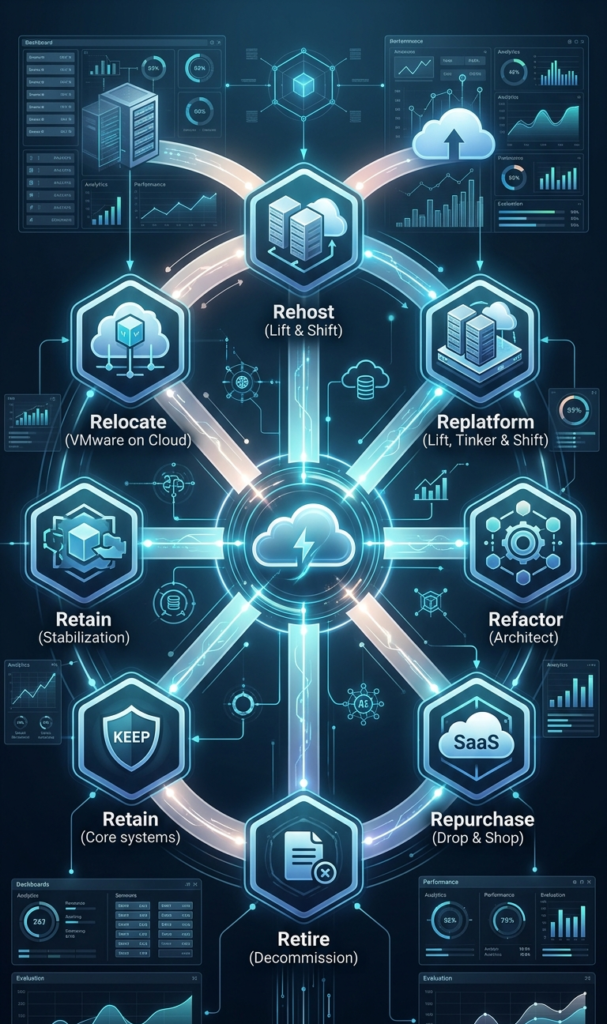
The 7R Assessment Framework: Defining the Optimal Cloud Migration Strategy
The 7R framework provides a structured approach to evaluate and determine the most suitable cloud migration pathway for each application within your organization’s portfolio:
- Rehost (Lift and Shift):
Migrate applications to the cloud with minimal or no modifications to accelerate deployment. - Relocate (Hypervisor-Level Migration):
Transfer workloads to the cloud without redesign, typically at the infrastructure or virtualization layer. - Refactor (Re-architect):
Redesign applications to fully leverage cloud-native capabilities, improving scalability, performance, and resilience. - Replatform (Lift and Reshape):
Make targeted optimizations to applications during migration without altering their core architecture. - Repurchase (Adopt SaaS):
Replace existing applications with cloud-based SaaS solutions to enhance functionality and reduce maintenance overhead. - Retire (Decommission):
Identify and eliminate redundant or obsolete applications to optimize the IT landscape. - Retain (Hybrid Approach):
Maintain select applications on-premises or in local data centers due to regulatory, latency, or strategic requirements.
This framework enables organizations to align migration decisions with business objectives, ensuring a balanced approach to cost, performance, and innovation.
How to Start Cloud Migration: Avoiding Failure with Expert Guidance
A successful cloud transformation requires a strategic, well-governed approach. The following key considerations help organizations minimize risk and maximize value throughout the migration journey: